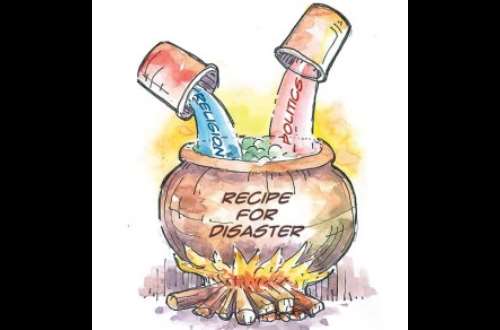
Mahatma Gandhi once remarked that “those who say religion has nothing to do with politics do not know what religion is”. However, Frank Herbert was of an entirely different opinion. According to him, “when religion and politics ride in the same cart, the whirlwind follows.” While Vinoba Bhave also described religion and politics as “obsolete”, and called for “science and spirituality to take over”, in Sam Erwin’s view, “political freedom cannot exist in any land where religion controls the state, and religious freedom cannot exist in any land where the state controls religion.”
Arising From the foregoing, one can safely conclude that the contest for space between religion and the State for hegemony and prominence is far from being over. Yes, they are both but different institutions! Conventionally too, religion, as it were, is a wholesome part of culture, even as the people in politics are also ‘people of culture.’ Whereas, the State derives its supremacy and nourishments from extant laws in the Constitution of Nigeria, which is the Grundnum, religion is in a class of its own, deriving sustenance from its firm belief in the supreme extra-terrestrial omniscience force, which controls the affairs of mortal beings. Be that as it may, the only trouble is that both institutions are products of the society, being managed by people from within the same society. Unfortunately, when people talk about institutions, they always seem to have forgotten that the society that owns the religious institution also owns the political institution. The more reason they exempt themselves as if they are not part of that society.
Beyond Edward Tylor’s description of ‘Culture’ as ‘the totality of the ways of the people’, it is doubtful if a society can survive without having a peculiar culture. For instance, Chairman Mao understood the import of socializing the minds of little Chinese children; and the results were not disappointing! Japan also developed because she closed her borders and ensured that, no matter what part of Japan he or she hailed from, a Japanese was always willing to die in the service of the king. Stated in clear terms, a Japanese would rather kill himself than for his country to go down! Here in Nigeria, whereas there’s hardly a Yoruba man who hasn’t been preached to, and has not decided, either for Islam or Christianity, only the smart ones among the politicians have succeeded in maximizing the advantage of the platitudes that religion offers for their selfish reasons; of course, to the detriment of the state.
Religion exists and its focus at the beginning was the Heavenly Kingdom. In other words, religion at the outset didn’t have anything to do with the government on earth – worldly kingdom. Impliedly, though religion may have a large following in the society, with most of the citizens under its influence, it does not control the entirety of the society. When the State eventually emerged as an independent entity, carrying along with it the power of sovereignty, not only did it attract more people to its fold but the influence of religion upon the society also became weakened.
Whereas the state also has the monopoly of the use of power of violence, it is not so with religion, it is not so. In the most, the State operates on the principle of legal rational order while religion operates on a largely restricted order, prescribed only by the deity. Besides, the State must be seen as religion-neutral; and must give all citizens formal and secular benefits, irrespective of their beliefs. Regrettably, in modern State situation, the State has overreached its limits of prescribed obligations and responsibilities. Therefore, is it any wonder it’s now faltering in what, originally, were the responsibilities of religion before it (the State) came into being? How then do we separate the huge frustration within the society, which, for instance, led to the #EndSARS mass protests in Nigeria, from how the State has so far fared?
Looking at the issue as it affects our world, religion is now a two-edged sword. As the compromised religion becomes depleted, both in capital and strength, the State, which thinks it has succeeded in decapitating religion, is also wounded. Not only that, as values are being attenuated by religion, so also is corruption being entrenched in the State. Thus, using the needle of religion as the oxygen to capture votes became another challenge on its own. Tragically, those who spoiled the show for religion neither went back to the river where they left their cloths nor contemplated the consequences of squandering its capital. Right now, in the minds of the people, ‘omo rere kan ko si ninu ibon’ (there’s no righteous being again)!
In the olden days, those who went into politics did so with their religious beliefs and inward attitudinal disposition. In modern Nigeria, the general belief is that every other person who is in politics is a thief. After all, nobody comes into the political arena, empty; only that the smart ones play to the positive side of religion with a view to helping themselves. In those good old days, you wouldn’t come to God’s House with stolen money. These days, people steal from the government, then go to the church for thanksgiving. In the time of old, we were told that, if you didn’t have nice apparels, you could still go to the church and worship your God; and you must not be disrespected. Not anymore! Anyone who attempts such in this computer age will most likely have himself or herself to blame. What’s more? These days, it is not uncommon for a religious leader who says the truth to become an enemy to the government. Of course, that’s why most of our ‘Lords Spiritual’ now find ways of accommodating the government, even when its excesses are quite obvious.
Basically, when we say that politics is about seeking the good of the majority, it does not mean that the interests of the minority should be jettisoned. What it simply means is that the objective interests of the majority will, first of all, be satisfied – to boost the legitimacy profile of the local politician within a given geographical spread – before considering the demands and agitations of the minority. That said, the threatening reality is that compromise is now the rule of the game: the State extends the proverbial olive branch to the religious institution; and the latter reciprocates with its cup of Goodwill Messages to the masses, urging peace and unity. Apparently, the interests of both the government and the religious institution are coterminous – peaceful co-existence among the people so that both parties can prosper!
Any lessons? Well, as Nigeria is gradually moving towards another round of General Elections, it behoves Nigerians to gird their loins; for God is God; and He is for all! That a particular candidate is a Christian, or a Muslim, or a traditional worshiper should not determine the voter turnout. Instead, politics, based on issues, should determine who rules and governs well. With it, the scorecards become easier to monitor and politicians are conscious of the essence of an abiding legacy. Politics of issues will not only bring instant relief to the electorate but can also drive our politics to make it more interesting and more productive. And that will be fantastic!
May the Lamb of God, who takes away the sin of the world, grant us peace in Nigeria!