
Malaria remains a public health threat in Zimbabwe, with more than half the population at risk of contracting malaria annually.
Despite the progress made, malaria still accounts for about 40% of outpatient attendances in the moderate to high transmission districts, especially during the peak transmission period.
Zimbabwe has adopted several chemical-based vector control measures to reduce malaria. However, there has been growing evidence of resistance to chemical-based malaria vector interventions.
This has necessitated the call for alternative non-chemical-based innovations for vector control such as house screening.
Recent studies have shown house screening to significantly reduce the number of mosquitoes entering houses in several African countries. However, it remains necessary to quantify the impact house screening has in malaria prevention and reduction effect in different countries.
Zimbabwe is among the six southern African countries in the WHO AFRO region where studies on demonstration of effectiveness of diversified, environmentally sound, and sustainable interventions, and strengthening national capacity for innovative implementation of integrated vector management (IVM) for disease prevention and control is being implemented.
The study is known as the AFRO II Project which is funded by the Global Environment Facility (GEF) through UNEP and WHO-AFRO. The project supports the implementation of the UNEP roadmap for development of alternatives to DDT (dichloro-diphenyl-trichloroethane) as endorsed by the seventh meeting of the Conference of the Parties (COP7) to the Stockholm Convention in May 2015.
The objective of the road map is to make locally safe, effective, affordable, and environmentally sound alternatives available for a sustainable transition away from DDT.
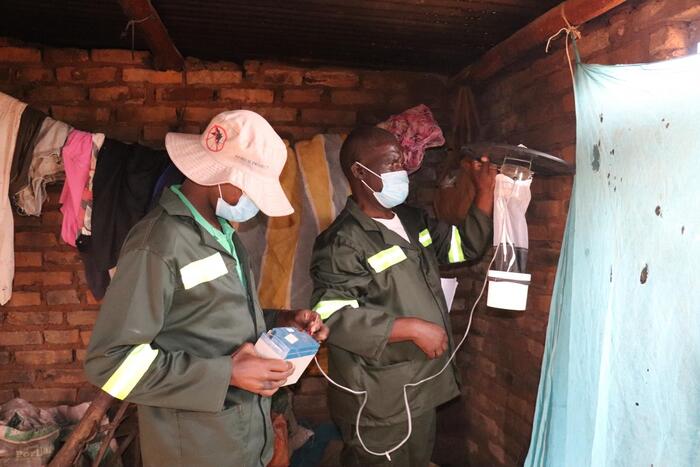
The Afro II project study in Zimbabwe covers wards 27 (Monyoroka Resettlement area) and 28 (Triangle) in Chiredzi District, Masvingo Province. The project involves the screening of houses by installing wire mesh screens on windows, doors, eaves, and other openings to prevent the entry of mosquitoes.
To start off the project the Ministry of Health and Child Care (MoHCC) with support from WHO conducted household enumeration, malaria knowledge, attitude, and practice (KAP) survey, and insecticide susceptibility mapping within the targeted community in the project district.
The KAP survey conducted in May 2021 was aimed at assessing the local community`s awareness and appreciation of malaria (the disease, causes, transmission, vectors, current interventions, and treatment).
Speaking on the sidelines of a project field visit in Chiredzi, Mr Wilson Chauke, MoHCC, National Vector Control Officer explained how the AFRO II Project was not replacing existing control measures but adding to existing malaria prevention and control mechanisms. “Zimbabwe is currently using chemical based vector control interventions and the AFRO II project is going to assess effectiveness of house screening, a non-chemical-based intervention. You know chemicals have an environmental impact which should be avoided at all costs.
“Should this project succeed, we look forward to having an additional intervention which is environmentally friendly,” he said.
Covering doors, windows, and any other openings with screens and closing off any remaining gaps with mortar is simple and effective.
Keeping mosquitoes out of homes not only prevents the transmission of malaria, but also several other tropical diseases like dengue, filariasis, or Rift Valley Fever.
Apart from protecting all members of the household while indoors, screening is also an environmentally friendly intervention as well as a lasting and more cost-effective option compared with use of bed nets alone.
“House screening was successfully tried in the Gambia and Tanzania and found to significantly reduce malaria transmission. It is also beneficial in that it is environmentally friendly and not prone to development of mosquito resistance. Again, it fosters community participation and ownership,” said Casper Tarumbwa, WHO Zimbabwe AFRO II Project Coordinator.
Results from the AFRO II Project are expected to assist in overcoming challenges such as reliance on chemical-based malaria vector interventions that are prone to resistance.
Scarcity of human and technical resources, and inadequate capacity for the enforcement of policies related to production and safe use of insecticides. The multi-sectoral approach to the implementation of the project will also enhance collaboration between the health and other relevant sectors with regards to developmental projects impacting on health.
After the preliminary activities outlined above the project has moved on to the next stage where the first phase of screening of 400 houses commenced on July 25, 2022 and will run until August 5, 2022.
When the screening is concluded evaluations will be carried out to determine if there is a reduction of mosquitoes entering houses, decrease in the number of new malaria cases and acceptance by the community.