
Global economic events in recent times are in a twist of fate especially as both developed and developing economies are still recovering from the unpleasant economic impact of the Coronavirus. Hence, we cannot forget in a hurry the global economic projection post covid-19 pandemic.

Nevertheless, just as the world was getting set to overcome the economic shock of the pandemic era, the Russian-Ukrainian war exploded with its own consequences, both in human casualties and resources calamities. State and non state actors have all lend their voices either for or against.
Conversely, what is generally perceived as the fall out of the war presently, the world cannot ignore is it impact on global economy. Specifically on energy – crude oil, gas, coal and wheat food chain supply.
Chiefly, the United Nations for instance specifically cautioned that the war would escalate “world food crisis”
This has left the entire global community to wake-up and set in motion how best to keep world food supply and distribution intact. However, the humanitarian crisis erupting from the war is a headache the world is grappling with.
Interesting, the foregoing is to help us appreciate the title and focus of this piece,
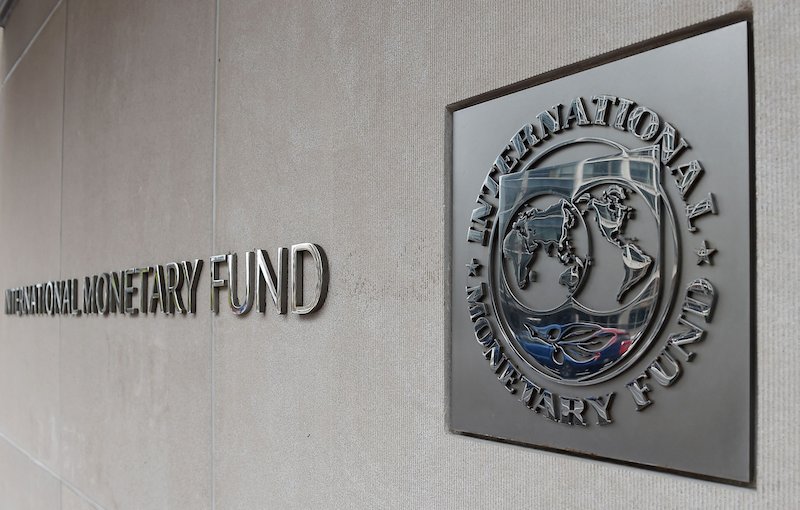
Dissecting the recent warning and forecast from the International Monetary Fund (IMF) on global economies, we can see the IMF in two successive reports that first upgrades Nigeria’s economic growth forecast to 3.4%.This was revealed in the Washington based Britton-Wood Institution ‘World Economic Outlook: War Sets Back the Global Recovery, report.
The second was a warning coming from the neoliberal lender in a report, titled “Emerging-Market Banks’ Government Debt Holdings Pose Financial Stability Risks”.
In the first report, the IMF was concerned with the global economic projection that it streamline to reveal the institution thinking about Sub-Sahara African economic growth, before religiously predicting that of African largest economy. The global economy according to the Washington-based lender is projected to slow from an estimated 6.1 per cent in 2021 to 3.6 per cent in 2022 and 2023. This recent updated is a departure from its January 2022 World Economy Outlook forecasted before the ongoing war between Ukraine and Russia.
On the Sub-Saharan African region it projected 4.5 per cent in 2021, 3.8 per cent in 2022, and 4.0 per cent in 2023.
Given the projection above, individual nation like Nigeria is not isolated from global economic event.
In retrospect the IMF earlier this year predicted a growth rate of 2.7 per cent for Nigeria in 2022. However, the latest update projection that is adjust due to active rising oil prices of which Brent crude stand at $106.86/barrel.
Unfailingly, also IMF disclosed a 3.1 per cent growth projection for the nation in 2023, down from 3.4 per cent in 2022 and 3.6 per cent in 2021.
This entire aforementioned national forecast on economic projection in clear terms is to help us evaluate what need to be done. On trending challenges the economy is contending with on daily basis.
On the second report, the IMF strongly said there is a possibility of “doom loop” for Nigeria and other emerging economies. In the report “Emerging-Market Banks’ Government Debt Holdings Pose Financial Stability Risks”. Sadly, a ”doom loop’ equally refers to a ‘diabolic loop’ and the popular ‘vicious circle’. This term from economic paradigm connotes an upward or downward harmful economic impact.
According to IMF, “large holdings of sovereign debt expose banks to losses if government finances come under pressure and the market value of government debt declines.” Meanwhile, the Washington lender disclosed that there is a reason to worry about this connection between banks and governments. This was pointed out in the report as ‘doom loop’ suggesting a negative spiral that can occur when “banks hold sovereign bonds and governments with weak public finances bail out such banks”.
Appreciably, we can understand this about Nigeria’s bank credit to the government. In recent time as taking a surging flight upward. Because as at February 2022 it stood at N14.9 trillion, an upsurge from the N14.2 recorded in January 2022.
Curiously, this specifically may be the lead to IMF warning about the danger of Nigeria’s huge domestic borrowing and threats to economic stability.
Although in what look like a sabotage according to IMF is holding government’s bond through credit “curtail lending to companies and households, weighing on economic activity.“
Thus, this could be a danger for a dependent market economy like ours, a situation where government have been told to hand over the economy to the private sector.
More so, if we consider the popular view of IMF with its baggage of “fundamentalist ideology of market forces and getting the right prices’. Instructively, the economy cannot rightly be private sector driven alone because to get the best of any economy required public sector participation. Unfortunately, there are arguments and counter argument on this.
Nonetheless, the fear of over-credit to the government is believed to be counterproductive. That sharply undermines investor confidence in the economy, as well as demarked commercial banks status. For instance, banks with less capital holding government bonds in their portfolios may be drawn into the risk, if government defaults.
Regrettably, the ability of emerging-market governments to repay debts throws up one critical question that begs for answer. Why are emerging economies like Nigeria so indebted to domestic banks and financial institutions?
The answer to the above question requires deep thinking because economists and the likes of IMF have told us there is nothing wrong in borrowing.
Nevertheless, we have seen with our own eyes that borrowing in itself stands to jeopardize and put pressure on the economy. Reason is that it is not going to be free from condition resulting from global financial uncertainties, interest rate spiral and weak local currency.
Hopefully, to remedy the situation from ‘doom loop’ towards impactful economic growth, the Nigerian state in all sense of urgency must seek legislative input to enforce the economic diversification agenda.
Secondly, government at all levels must seek alternative to borrowing from domestic or foreign sources.
They should priorities their development project with available funds and ensure accountability as well as prudency.
Lastly, the CBN and DMO must ensure strict adherence to monetary rules/guidelines especially to curtail excess and unwarranted bonds and credits to government. That could lead to bank stress, domestic shocks and unanticipated financial consequences.
We believe the CBN using the monetary policy can normalize any negative impact of domestic debt on local banks and financial institutions.
Adefolarin A Olamilekan is a Political Economist and Development Researcher, he can be reached at adefolarin77@gmail.com or 08107407870, 08073814436