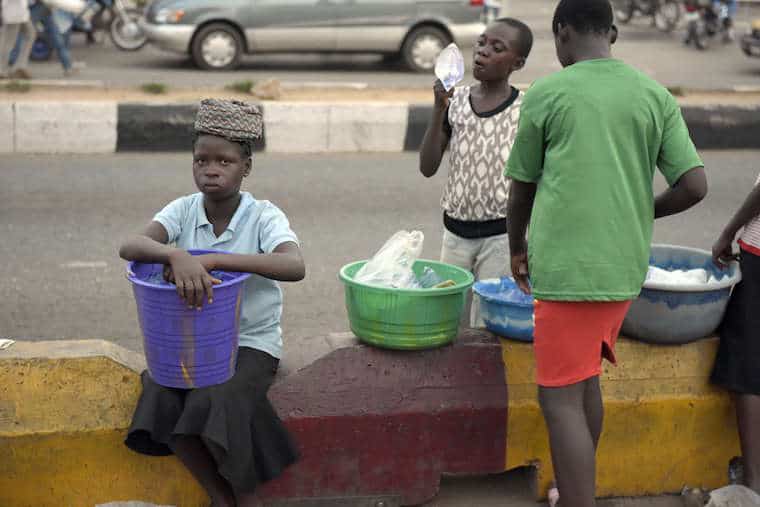
The (sleeping) Giant of Africa, the fading hope of the black race and unfulfilled potential called Nigeria now sits on a keg of gunpowder with the some of the worst development indices in the world. Leading the pack in poverty, insecurity, unemployment, maternal/infant mortality and being among the few countries yet to overcome vaccine-preventable diseases, it looks like a lost battle for this generation which Nobel Laureate, Wole Soyinka, called a ‘wasted generation’. Worse is the fact that it is becoming increasingly difficult to see light at the end of this tunnel because millions of boys and girls who will make up the next generation are being denied what should naturally be their basic, fundamental right: Education.

It was America’s inventor and statesman, Benjamin Franklin who famously wrote that: “If you fail to plan, you are planning to fail.” Successive leaders have over the decades failed to plan as the country’s population increased at alarming rates. What we now have is a large army of youths who are either uneducated, unskilled, untrained, unemployed, unemployable or all of the above. They were the kids who the nation failed to train 20 or 25 years ago. They can hardly help themselves to live a decent life and they add no value to the economy since the country’s policy makers have over the years overlooked the huge impact of human capital development in planning a better future. Many of them also constitute a serious menace to the country’s security.
The menace of Boko Haram insurgency in the northeast and other security problems are both causes and consequences of escalating figures of out-of-school children in the country as terrorists have destroyed thousands of schools, kidnapped and killed teachers and pupils, therefore making it difficult for willing parents to send their wards to school.
It is however not a problem limited to Nigeria; it’s a menace the entire sub-saharan Africa is grappling with. But Nigeria being the most populated of all Black countries does not only house the highest number of out-of-school children in the world but also a whopping two out of five and 45 percent of the entire West African figure.
The over 13 million out-of-school children today are the unskilled people the country is training for the future and with the accompanying dangers. That number is of course greater than the population of Togo and The Gambia put together.
According to the UNESCO definition, out-of-school children are kids of official primary school age who are not enrolled in primary or secondary school.
42 per cent of Nigerian children aged 6-11 do not attend any primary school with the northern region recording the lowest school attendance rate in the country, particularly for girls.
The Almajiri phenomenon in northern Nigeria
‘Almajiri’ education system is predominantly practiced in northern part of the country and it enables parents to give their boys who are mostly of primary school ages to itinerant clerics who take them to other cities with a view to teaching them Islamic ways of life. No provision is made for their welfare as they learn Quran and beg for food and money on the streets. They may never see their parents or family members again as many of them graduate from the school and grow up to become poor, menial traders or road-side artisans wherever they find themselves, even with no proper skills. The world ‘Almajiri’ is a corruption of the Arabic word “al-Muhajirun” which simply means intending Islamic scholars who leave their homes home in search of knowledge. It’s a practice which Islam encourages, but at adult age. The issues of parental irresponsibility and street begging are of course alien to the original idea of leaving one’s comfort zone in search of knowledge, they are simply Nigerian additions.
The fact that the National Council for the Welfare of the Destitute (NCWD) puts the figure Almajirai kids in northern Nigeria at 7 million and the Ministry of Education says it is 9.5 million out of the 13 million out-school children shows that the Almajirai education system is a major shareholder in the business of out-of-school children . In fact, Eight million of the 13 million out-of-school children are in 10 Nigerian states and Abuja – Bauchi, Niger, Katsina, Kano, Sokoto, Zamfara, Kebbi, Gombe, Adamawa and Taraba states.
About 69 per cent of the country’s out-of-school children are in the entire northern part of Nigeria. Bauchi State has the highest number with 1.1 million children followed by Katsina with 781,500.
Interestingly, Katsina state is where Nigeria’s President, Muhammadu Buhari, comes from. Interestingly again, both Bauchi and Katsina were not only two of the states he got his highest votes from in 2015, they were indeed the two states in which he was so loved that his 2015 opponent, a sitting President, Dr Goodluck Jonathan, was violently attacked and pelted with stones when he went to the two states to campaign. Ironically, again, while it was President Jonathan who built Almajirai schools (for learning both western and Islamic ways) with a view to taking the kids out of the streets without getting the support of the northern elite, President Buhari did not lift a finger or raise a voice to address the problem in his first term in office.
This however changed in the second term as the President Buhari told governors in a meeting in Abuja in 2019 that urgent steps must be taken to send Almajirai kids out of the streets and enroll them into schools.
The north is the major contributor to the menace of out-of-school children in the country due to the problems of poverty, unhelpful cultural practices, wrong understanding of religious provisions among other factors.
The southern angle
The southern part of the country also contributes its own quota to the menace. Rural-urban migration and poverty are the major causes as cities like Lagos, Ibadan, Abeokuta, Warri, Port harcourt etc house an unfair population of Nigerians and children of primary school ages can be seen hawking Gala, sachet water and so on in traffic jams.
According to the 2016/2017 Multiple Indicator Cluster Survey (MICS) the South-East accounts for the lowest number of out-of-school with 11.3 per cent followed by the South-South with 13.3 per cent and South-West 14.6 per cent.
If we continue like this, the dream of the country meeting the UN’s universal access to basic education by 2030 may be a mirage.
Way out
It’s not a lack of capacity, but a lack of political will. According to the Education for All Global Monitoring Report by UNESCO which was released at the World Economic Forum on Africa, of the 17 countries analyzed, Nigeria can provide education to 2.4 million of her out-of school-children (OOS) children if the country’s natural oil revenue is well managed. Findings of the paper also indicated that Nigeria could raise almost half a billion US dollars annually for education if 20 per cent of its oil revenue were invested in that crucial sector. The amount raised would be almost three times the amount Nigeria currently received in aid to education. The paper noted these could finance access to primary school for 86 per cent of their OOS children or 42 per cent of their out of school adolescents if their natural resources are properly managed.
Indeed, time has come for the President of Nigeria to summon a meeting of stakeholders – governors, monarchs, clerics – and agree a 4-year plan for the eradication of the Almajiri education system as it has clearly done enough damage. The President must summon the balls to declare an emergency on the situation and give a marching order (at least he gave one in 2019 when his second term ambition was threatened, that anyone who stole ballot box should be killed on the spot!) that he doesn’t want to see any child begging or hawking on the street anywhere in Nigeria by the time he is leaving office in 2023.
The full implementation of the Child Rights Act and other relevant legislations on child abuse will really help. The Child Rights Act has not been domesticated in many northern states because of the controversy around puberty and age of marriage for girls. The act prescribed 18 as the minimum age for marriage among girls. There is hope in the horizon as the Kingdom of Saudi Arabia has now banned marriage below the age of 18. It is time to take a cue from that development.
According to a UNICEF Child Protection Specialist, Sharon Oladiji, northern states such as Sokoto, Kano, Zamfara, Kaduna, Jigawa, Katsina, Bauchi, Yobe, Borno, Adawama and Gombe are yet to domesticate the CRA while those that have domesticated the law are Niger, Nasarawa, Taraba, Benue, Plateau, Kwara and Kogi. All the 17 states of the South have domesticated the Act. The act definitely makes it mandatory for all kids of school age to be in school and also prescribes punishment for parents or guardians who fail to comply. With the full implementation of this Act, the clerics who feed on the misfortune of innocent Almajirai will no longer find a place to hide.
Most importantly, emphasis must be placed on quality education, breeding of talents and skill acquisition. If Nigeria must join the league of serious nations, we must stop sponsoring and subsidizing peoples’ religious practices and individuals’ personal fantasies from the public purse. Monies meant for sponsoring pilgrimages to Mecca and Jerusalem should be diverted into education while state resources used in some northern states to sponsor marriages (a deplorable practice that encourages indolence and increases the number of irresponsible parents and out-of-school children) must be diverted into making the schools up to standard for the kids. For parents to stop giving excuses on poverty, governments must at all levels make basic education free and outlaw child hawking and begging. The UNESCO prescription of 26 percent budget for education is actually for normal climes. Nigeria is in emergency at the moment, so we must do more than that.