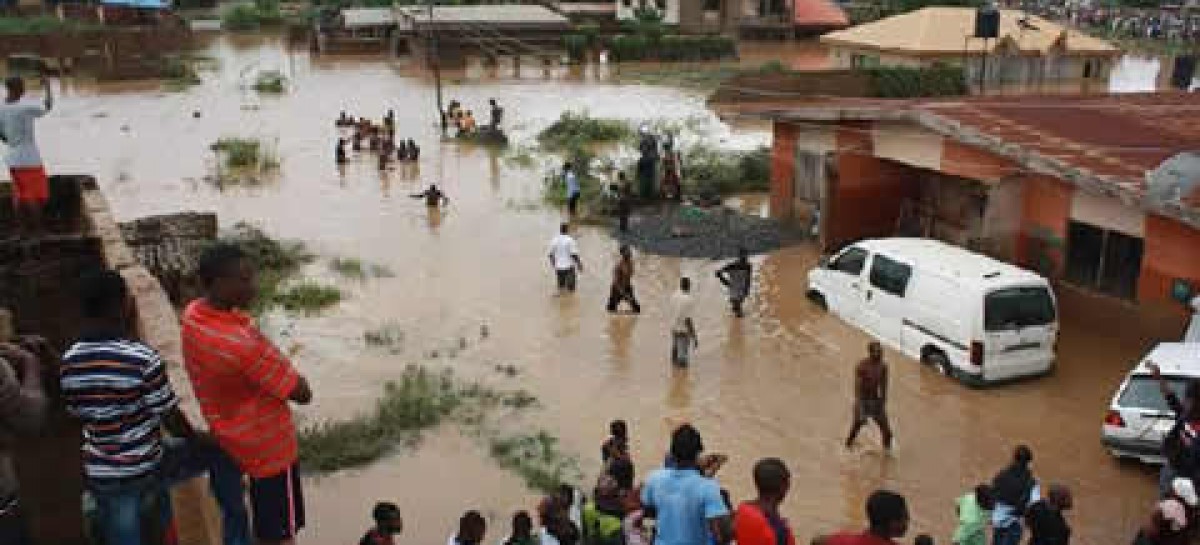
One of the most prevalent natural disasters in Nigeria is perennial flooding. Some states are increasingly experiencing annual flooding during the rainy season.
Increasingly, a link is being made between increasing flood incidences and climate change.
Unlike some natural disasters, rainfall flooding can be controlled with proper planning and provision of necessary infrastructure. Nigeria’s flooding is mainly human induced with poor urban planning practices and inadequate environmental infrastructure being contributing factors.
In 2012, Nigeria experienced its worst flooding recorded in recent history. Total losses were put at US$16.9 billion.
The extent and nature of Nigeria’s flooding are such that the actual figures for displacements, losses and fatalities cannot be truly ascertained due to poor records and reporting.
But flooding threatens sustainability because it negatively affects the economy, health, social life and environment. Flooding constitutes a threat to Nigeria achieving the global sustainable development goals.
My recent paper highlights why. As part of my PhD research, I study flooding within the context of sustainable development, environmental justice and flood risk management.
The sustainable development goals are global goals for achieving environmental and human development by 2030. Of the 17 development goals, nine are directly affected by flooding. These include eradicating poverty and hunger as well as providing clean water and sanitation.
In the case of Nigeria, flooding has had a major impact on the country’s development goals in relation to the social, economic and environmental targets.

Drivers of flooding in Nigeria
Nigeria’s flooding is mostly human induced and exacerbated by human-nature interactions. Poor or non-existent drainage systems are a major cause of flooding.
Many residential areas have no drainage system and rely on natural drainage channels. Increasing urbanisation also means more areas are built with concrete and cannot absorb water, increasing runoff.
Poor waste management is another recognised factor. Citizens’ poor attitude to waste disposal and non-provision of waste disposal services by municipal authorities contributes to flooding. It is not uncommon to have drains blocked by refuse in urban areas.
Other factors are unregulated urban expansion – Nigeria is experiencing high urbanisation rates without commensurate provision of urban infrastructure and amenities. Agricultural lands are increasingly being converted to residential areas to accommodate housing needs.
But there’s lax implementation of planning laws. One consequence of this is the there have been construction projects on natural floodplains and storm water paths. This has exacerbated flooding.
Corruption is also a factor. It is not uncommon for town planning officials to accept bribes and overlook issues. These may include unauthorised use of land and alteration of approved construction plans.
Some citizens also capitalise on the loophole of ineffective development control and extend their buildings over the approved areas. Sometimes they go as far as building over drains.
What needs to be done
Nigeria’s president Muhammadu Buhari recently blamed flooding for the rising food insecurity in the country.
But what is missing is appropriate action to mitigate the flooding. Currently, there is no flood management policy in Nigeria. The lack of relevant legal and policy frameworks is an indication of the low importance given to controlling and managing flooding in Nigeria.
Integration of flood risk management with spatial planning is the way to go.
Historically, Nigeria has been more focused on post-disaster flood response than control. Reducing and addressing exposure to flood risk is now a national priority in the Nigerian government’s disaster risk management agenda.
However, nothing concrete has been achieved. This is not encouraging despite the comprehensive post-disaster needs assessment conducted in 2012 by the federal government with international collaboration.
This raises questions on the political will to achieve this goal.
The government is not lacking research institutions and agencies with the skills to design a flood risk management strategy. For instance, the National Emergency Management Agency has a department of planning utilising geographical information system to work on flood data. Still, there are no effective national early warning system in place for floods at the federal, state, and local governments.
The Nigerian Meteorological Agency, on its part provides seasonal rainfall predictions, but communication remains a problem. Integration and coordination are lacking among the existing government bodies who sometimes carry out flood control projects without liaising with each other.
Sustainable urban planning and green infrastructure could also be combined with information and communication technology tools. Citizens can use these to communicate with the relevant authorities at the onset of flooding.
Addressing Nigeria’s perennial flooding is important for the country to make progress. The human-induced causes of flooding should be addressed urgently. Not doing this will delay its journey to sustainable development.