
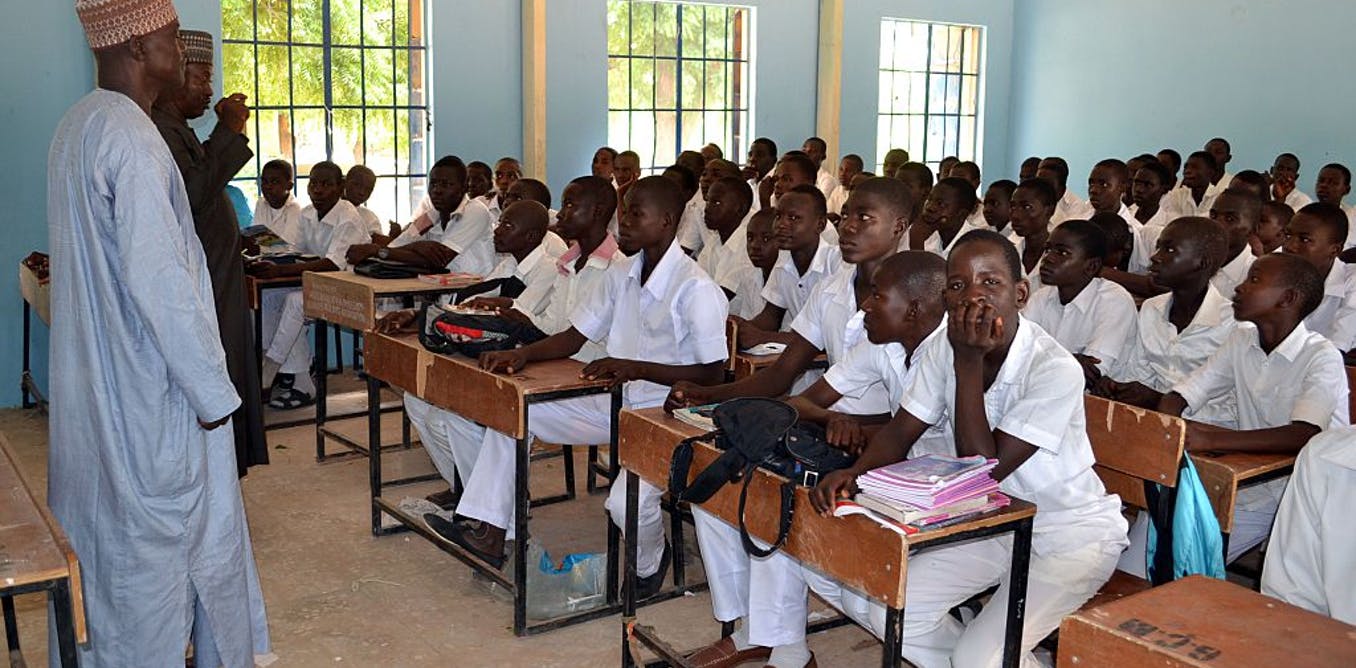
Schools are among the worst institutional casualties of complex disasters. This has been the obvious case with the ongoing COVID-19 pandemic, the Boko Haram insurgency and other violent conflicts in Africa, which have caused the suspension and destruction of schools.

Countless schools have been damaged, closed or destroyed. Untold millions of students have been forced to suspend or to abandon their education because of violence or the pandemic. These disruptions have further blighted the already precarious educational foundation of the continent.
So what’s the most cost-effective way to address this enormous challenge?
In an area confronting the Boko Haram uprising in north eastern Nigeria, we used a combination of radio and computer tablets to improve the literacy and numeracy skills of 22,000 children forced out of school.
Our findings show that radio and mobile technologies can support a swift and sensitive response to educational disruption. The outcomes are even more positive in contexts where girls have been most affected. The nature of instructional radio and technologies has a direct consequence on learning outcomes across variables such as gender and age.
The findings offer important implications and lessons for ongoing COVID-19 education continuity response programmes across the African continent.
The project
We developed the Transactional Radio Instruction model as part of a USAID-funded Technology Enhanced Learning for All project at the American University of Nigeria in Yola, Adamawa State, Nigeria at the height of the Boko Haram insurgency between 2015 and 2016. The region is one of the poorest and most illiterate in the country. Girls were particularly disadvantaged.
We randomly assigned beneficiaries into three different groups across 750 learning centres to test the impact of a blend of remote learning media on learning outcomes. We then conducted baseline standardised Early Grade Reading Assessment and Early Grade Mathematics Assessment tests to ascertain participants’ literacy and numeracy levels prior to the intervention.
After six months of the programme, we conducted end-line tests on the same sample, again using standardised tests. We observed an average improvement of 99.1% in literacy scores and an average improvement of 97.2% in numeracy scores. Even within the context of a regular classroom, these were extraordinary improvements. And within a very short time.
How we did it
We designed the radio-based lessons as a radio drama series. This was accompanied by easy to memorise songs in Hausa, interspersed with English. Every episode sought to unpack and creatively confront obstacles that interfered with learning. We achieved this by weaving problem-based lessons into stories that helped learners overcome cognitive and cultural barriers to learning.
The programmes especially sought to confront the various religious and socio-cultural factors and practices responsible for female educational deprivation in northern Nigeria. We created more female characters in both the literacy and numeracy drama series. The radio teachers in both programmes were also female and three out of the four children on radio were girls. We observed a correlation between the gender of the radio characters, participation and learning outcomes.
We built a central character into the numeracy story line to play the role of a patriarch who wields enormous social influence. By characterising the patriarch as a co-learner and an advocate of education for all, we successfully built a cultural validation into the programme’s structure.
This was critical because, in northern Nigeria, the grandfather is responsible for maintaining cultural and religious norms in the family. We were hardly surprised when participants voted the patriarchal character as the most popular character on the show, over the class teacher.
Lessons learned
There are many lessons worth sharing. But we will focus on three salient ones.
First, it is crucial to clearly establish a connection between cognitive development activities and learners’ lived experience in designing programmes. A problem-based learning approach is critical. Students learn better when they solve a coherent set of problems (based on clear prompts and hints) related to their lived context and among a group of peers. It means that their perception of the subject is derived from the everyday problems with which they might well be confronted, not from abstract titles, labels or calculations.
For example, if students’ perception of geometry is derived from the real-world problems, they are more likely to be interested.
Second, the core objective should be to inspire a love for continuous learning. This is very important, particularly in societies where schools have been disrupted for a lengthy period.
Lastly, radio is a potent medium for teaching and learning. When creatively designed, radio instruction can provide an effective, swift, and low-cost solution to educational disruptions. Its reach and accessibility, particularly in Africa, can help meet the educational needs of large numbers of learners over a wide geographical area.
Next steps
USAID and the World Bank are proposing using our Transactional Radio Instruction model as part of a COVID-19 education continuity program to support some 500,000 learners in northeast Nigeria. When combined with tablets, even once a month, learning outcomes can improve significantly.
Children exposed to a combination of lessons on both radio and computer tablets once a month out-performed those exposed only to the radio programs by an average of 25%.
Moreover, in both literacy and numeracy tests, girls improved significantly more than boys – the difference being an average of 20% and 25%, respectively.
But this is just a first, small step.
There is need for an education intervention mechanism that assures education simultaneously with humanitarian protection and material assistance during complex disasters. It should seek to address the immediate educational needs of refugees, displaced persons and societies under siege, while a lasting solution is pursued.
This will require the involvement of a range of actors. These should include local education authorities, donor and national governments, international agencies, community-based organisations, academic experts and local leaders.
The future of Africa, and particularly a democratic Africa, can only be sustained with an educated population. Here is one cost-effective approach to building that future, that should be supported by the new Biden administration and other international donors.