
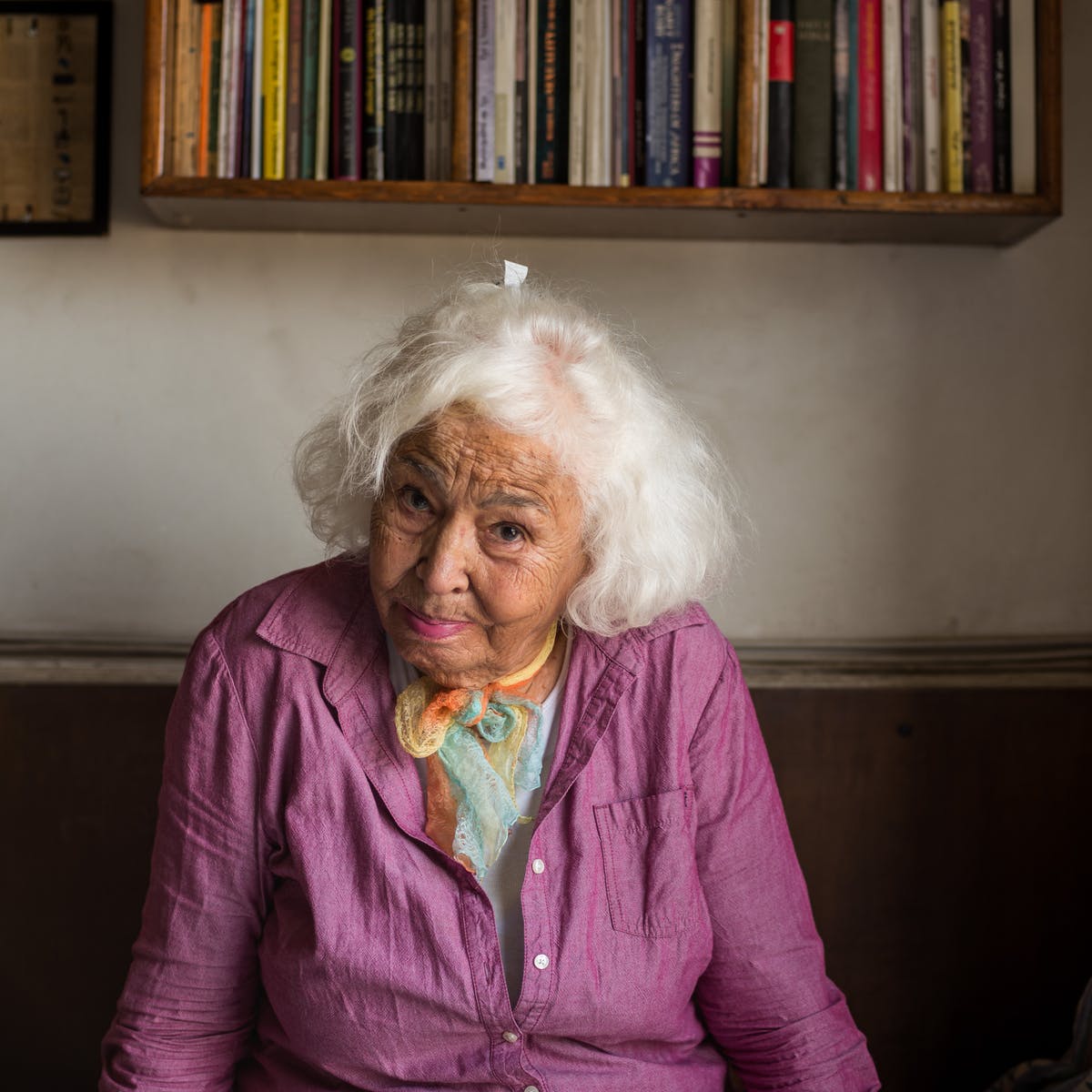
The Egyptian author, physician and activist Nawal El Saadawi’s recent death has brought her writing back into the public eye.

This is an opportune return, because El Saadawi’s feminism was ahead of its time – in both the Arab and the African worlds.
In a recent analysis, I focused on her 1975 novel Woman at Point Zero. El Saadawi published over 50 books in her lifetime, many of them novels. Woman at Point Zero, the first of her novels to cause public controversy, tells the story of Firdaus, a woman born into poverty in Egypt who survives genital mutilation and several abusive relationships before becoming a sex worker.
I maintain that the novel occupies the extreme edge of radical feminism, and that this is why it has been either neglected or reviled by commentators from the global south. The dominant feminist theories of the time could not accommodate its radicalism.
Different feminist theories
Arab feminist theory is deeply implicated with patriarchal religious debate. By contrast, African feminism is largely secular (not concerned with religion). It appeared in the 20th century as somewhat moderate, mostly positioning itself in opposition to western feminism. With some justification, African gender theorists denounced western feminism as a form of cultural imperialism against which African traditions needed defending.
Though their thinking on gender was overwhelmingly binary, 20th-century African feminists insisted on the inclusion of men in every progressive crusade. They declared gender issues to be inextricably entangled with other systems of injustice and exclusion such as racism, colonialism and capitalism – what’s today defined as intersectional feminism.
Many rejected the name “feminism” and defined alternative movements such as womanism, Stiwanism, motherism, Umoja, nego-feminism and African womanism.
In the 21st century African feminism is changing – particularly in the South African context. Young women, constantly apprised of the rate of gender-based violence in their country, are losing patience with men. On social media, hashtags such as #MenAreTrash and #AmINext are becoming viral commonplaces in response to horrifying growth in sexual harassment, rape and femicide. The term “rape culture” is used widely, especially on university campuses, where outrage at gender-based violence has spurred consciousness and debate but sometimes resulted in the abuse of men suspected of rape.
In El Saadawi’s Egypt today, too, a burgeoning #MeToo movement continues to take to the streets and to social media.
The radical edge
Classical Western feminism, as propagated by such theorists as Kate Millett, Mary Daly and Andrea Dworkin, sees patriarchy, in all its forms, throughout history and in all societies, as the foundational system of injustice. Patriarchy is dominant and underlying, not equal and intersectional with, all other systems of oppression.
The most radical fringe of western feminism is probably embodied in such writings as the anonymous 1974 C.L.I.T. Papers, which advocate a complete severance and separation from men, and Valerie Solanas’s 1967 SCUM Manifesto, which demands that all men be killed.
The first English edition. Zed Books
El Saadawi’s novel is no less radical. In Woman at Point Zero every male character without exception is an unreclaimable member of the patriarchy who exploits or abuses women – in particular the female protagonist Firdaus – whenever opportunity presents itself. Some women characters are also recruited into the patriarchy, which is an overarching system of oppression to which even capitalism is subordinate.
The narrator goes to some lengths to make the point that all men are equally implicated. Firdaus’s father eats all the food in the house in times of scarcity and beats his wife and children. Her uncle abuses her sexually and marries her off to an elderly, physically repulsive husband when she becomes a liability. Her husband beats and abuses her. The man who rescues her from her marriage later turns her into a sex slave. A young revolutionary she falls in love with dumps her for his rich employer’s daughter. During her time as a prostitute both the “johns” and the pimps are constantly working to undermine her independence and steal her income.
Firdaus kills a man
In the climactic moment of the book, Firdaus kills a man. The fact that the man is, individually, a murderous pimp, seems irrelevant at this moment. Firdaus experiences an epiphany in which she realises that she “hate(s) him as only a woman can hate a man, as only a slave can hate his master”.
“A woman” is any, or every woman, “a man” is any man. Her action is generalised so that the two characters are not individuals but representatives of their gender. The woman’s hatred is exclusive to “only” the absolutely oppressed; the distinction between women and slaves is obliterated.
Swiftly taking the knife with which the man would have attacked her, she stabs him again and again, with redundant and extravagant violence. She is “astonished to find how easily her hand move(s) as (she) thrust(s) the knife into his flesh”, despite the fact that this is an unfamiliar experience to her. Led on by her sense of ease and fitness, her next thought is the crucial question:
Why was it that I had never stabbed a man before?
Her answer, “fear,” which can and should be overcome, is a sign that this act can and should be universalised.
Firdaus’s action is clearly endorsed as the appropriate response not just to her own situation, but to that of every woman. Nothing in the book contradicts it, from the narrator’s reverent attitude to her protagonist to the ways in which all the women in Firdaus’s prison – including the female guard – believe that she is innocent and treat her as a martyr.
Firdaus is eventually executed. But her uncompromising response to the man in her way is the only solution that this novel offers to the problem of patriarchy. It may not be a charitable – or even a practical – solution, but it is the logical outcome of a radical feminism.
It exists as a warning not just to the patriarchy itself but to those who compromise or negotiate with the patriarchy and all its allied systems of inequity.