

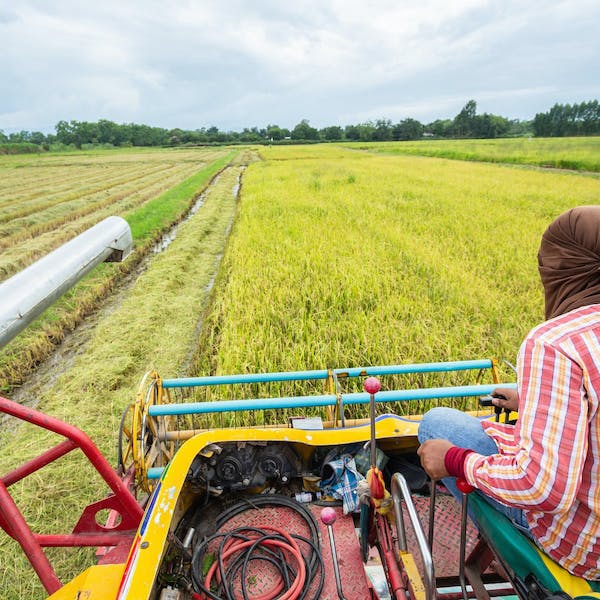
Processing agricultural products – adding value by transforming them from basic commodities – increases their worth, appeal and market value. In the case of rice, processing is an important and distinct feature in its production. It involves changing harvested paddy into edible rice.

Nigeria’s rice processing techniques are inefficient. This has resulted in processed rice that’s too expensive and of a lower quality than rice from other countries like China, Vietnam and India.
Rice, one of the major staple foods in Nigeria, is consumed across all Nigerian socioeconomic classes. Still, only about 57% of the 6.7 million metric tonnes of rice consumed in Nigeria annually is locally produced. This leads to a supply deficit of about 3 million metric tonnes, which is imported.
Over 80% of locally produced rice comes from small scale processors with a processing capacity of less than 100 tonnes. And these small scale processors are faced with financial challenges that inform their choice of equipment. Large scale processors, on the other hand, constitute less than 20% of processors. They face the challenge of inconsistency in grain quality and insufficient paddy. Both small scale or cottage rice processors and large scale processors depend on paddy from farm lands or purchase from neighbouring villages or towns.
The processing procedure entails parboiling raw rice to soften the husk, drying and milling it before selling to distributors or retailers. After milling, small stones must be removed using a de-stoner. De-stoning rice makes locally processed rice more appealing. But the majority of the small scale processors cannot afford this equipment unless they form themselves into co-operatives to purchase one.
We conducted research to establish why Nigeria’s processed rice was of low quality. We wanted to establish what drove the decisions of Nigerian rice processors, specifically their choice of the techniques for the processing of rice.
We found out that, in many instances, Nigerian rice processors, especially the small scale or cottage processors, do not have adequate processing capacity. We discovered that the choice of techniques and equipment used during processing was a major determinant of output and quality. The choices rice processors made were driven by a host of factors. These included budgetary constraints, social and economic factors as well as processing constraints.
Factors affecting processing decisions
In a bid to identify the factors affecting rice processors’ decisions, we administered structured questionnaires to 410 rice processors selected from four states – Ebonyi, Ekiti, Ogun and Nasarawa – from three geo-political zones in Nigeria – Southeast, Southwest and North-Central. We asked them about processing. We wanted to know about their experiences, where they sourced their raw rice, their processing activities and techniques, if they had available credit to enhance their processing activities and the distance covered from farm to processing centre and from processing centre to the market.
The responses to the questions showed that choices were dependent on each processor’s finances and a number of social and processing characteristics. These included the age (youth or elderly), sex, education, marital status and household size of processors. Economic factors also played a role, including access to a loan to buy modern equipment, and the size of the processing operation. Even if they could afford new equipment, most didn’t have the capacity to service it.
Consequently, there were instances where processors formed themselves into co-operatives in a bid to access loans and other financial aid from the government with the aim of purchasing processing equipment. But the time lag for loan applications delayed productive activities. The outcome was many processors became discouraged, and abandoned trying to use new processing techniques and equipment. There were also instances where processors couldn’t get spare parts and de-stoning machines required to sift raw rice.
Organised markets in the country present obstacles too. They opted for parboiled imported rice from countries like Vietnam, Indonesia, China and India instead of locally processed rice. This is because to process a 50 kilogram bag of rice locally is more expensive and not economical.
Rice processors also encountered challenges with getting consistent quality and quantity of rice from local farmers all year round. They had to deal with fragmentation of the processing enterprise that makes it difficult to create quality brands and standards due to exorbitant cost of processing equipment.
What needs to be done
In 2019 the Nigerian government restricted the importation of rice into the country. But the directive failed to address the fact that locally processed rice is too expensive. In the case of low priced rice, the quality is poor.
There is therefore a need for the Nigerian Ministry of Agriculture and Rural Development to focus on how to get modern rice processing techniques to more processors. This would enable processors to take advantage of the openings and opportunities made available by the federal government.
This should include providing machines and equipment to rice processors in a bid to ensure Nigeria can produce high quality rice.
In addition, rice processors’ associations should be supported with input supply and credit. Female processors should be empowered with input supply, access to credit and proper monitoring. The research has shown that they are more likely to use traditional techniques than their male counterparts.
Finally, stakeholders such as the federal and state agriculture ministries, local governments and the private sector, should invest in modern rice processing equipment. This equipment should be situated close to rice processors with good access roads. This will ensure that processors aren’t burdened by the extra cost of transport and rice processing fees which most rice processors are not willing to pay.