
By Peter Bergen, CNN National Security Analyst

One of the big themes of the concluding session of the Democratic convention Thursday was that Hillary Clinton would be a strong and effective commander in chief, while Donald Trump would most decidedly not be. At the convention, the usually mild-mannered, retired Marine four-star Gen. John Allen, who commanded forces in Afghanistan and later was the U.S. envoy to the anti-ISIS coalition, gave a stem-winding speech strongly making this case.
Allen said with Clinton in the Oval Office, “Our international relations will not be reduced to a business transaction. Our armed forces will not become an instrument of torture, and they will not be ordered to engage in murder or carry out other illegal activities.” Allen also made the case forcefully that with Clinton at the helm ISIS would have much to fear: “We will pursue you as only America can.
You will fear us. To ISIS and others like you: We will defeat you.” Next up was a gauzy film about Clinton, narrated by Morgan Freeman, that reminded Americans that as secretary of state she had endorsed President Obama’s decision to send into Pakistan a U.S. Navy SEAL team on a risky mission to capture or kill Osama bin Laden in 2011. In the speech accepting her party’s nomination — surely the most important of her career — Clinton said that as secretary of state she had traveled to 112 countries representing the United States.
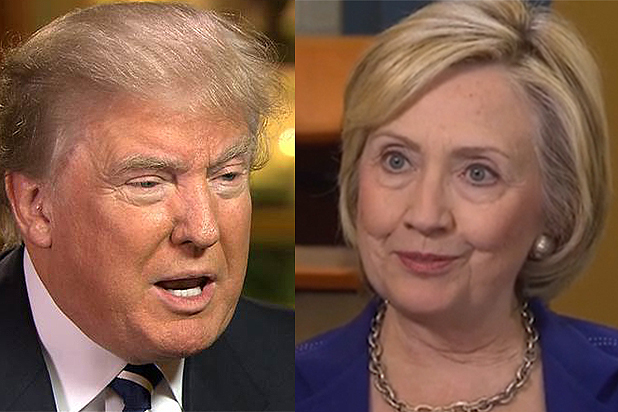
The contrast with Trump’s record of zero public service and his cartoonish understanding of the world at large didn’t need any underlining. She also forcefully made the case that she would wage war on terrorists saying, “Anyone reading the news can see the threats and turbulence we face. From Baghdad to Kabul, to Nice and Paris and Brussels, to San Bernardino and Orlando, we’re dealing with determined enemies that must be defeated. So it’s no wonder people are anxious and looking for reassurance — looking for steady leadership.” Clinton took aim at Trump’s claim, “I know more about ISIS than the generals do,” saying “No, Donald, you don’t.” She also asked with rising derision in her voice, “Ask yourself: Does Donald Trump have the temperament to be commander in chief? … Imagine him in the Oval Office facing a real crisis.
A man you can bait with a tweet is not a man we can trust with nuclear weapons.” Given the portrait painted Thursday that Clinton would be a strong and effective commander in chief in contrast to Trump, does her record bear this out, and how might her approach differ from Trump’s? Clinton, unlike Trump, has an extensive foreign policy record to examine based on her four-year tenure as secretary of state, which can help us understand how she might operate as commander in chief. As secretary of state, for example, she presided over the effort in 2010 to significantly tighten sanctions on Iran, which helped to bring the Iranians, eventually, to the negotiating table on their nuclear program.
This diplomatic effort resulted in a 12 to 2 vote in the U.N. Security Council to enhance sanctions against Iran, “one of her major achievements as secretary of state” according to New York Times’ reporter Mark Landler in his authoritative book “Alter Egos.” This move highlights what could perhaps be most distinctive about Hillary Clinton as president: her refusal to be typecast as either hawk or dove. Instead, she has long been resolutely both, advocating for military interventions in Iraq, Libya, Afghanistan and Syria while also being unafraid to express her support — as in one noteworthy 2011 episode in which she and then-CIA director Leon Panetta got into a shouting match over CIA drone strikes in Pakistani territory – for critiques of the use of force.
It is this record as both hawk and dove that suggests some of the contours of what a Clinton foreign policy would look like. What is also very clear from her record is that Hillary Clinton is now and presumably would continue to be as president a hawk who is also willing to negotiate. When it comes to foreign policy, these are the qualities we should most associate with effective commanders in chief. America’s two big foreign policy ideas As president, either Clinton or Trump will have to navigate the two big ideas in American foreign policy: isolationism and interventionism. As was memorably defined by U.S. Secretary of State John Quincy Adams in 1821, isolationism means: “America does not go abroad in search of monsters to destroy.
She is the well wisher to freedom and independence of all. She is the champion and vindicator only of her own.” In other words, the United States will not become embroiled in foreign conflicts over ideals like ”freedom” and “democracy” and will instead concentrate on strengthening itself at home. By contrast, interventionism stipulates that the United States needs to uphold — and even enforce — global order and liberty not only because it’s the right thing to do, but also because it’s very much in America’s own interests, a view best expressed by John F. Kennedy in his 1961 inaugural address at the height of the Cold War when he said, “We shall pay any price, bear any burden, meet any hardship, support any friend, oppose any foe to assure the survival and the success of liberty.
“ Over the past century the United States has swung back and forth between periods of isolationism and interventionism. Isolationism kept America out of World War I until the end of the conflict and it was relatively late to send troops to join the alliance fighting the Axis powers during World War II. After that war, America emerged as the dominant world force of interventionism, spearheading the global architecture of NATO, the United Nations, the World Bank and the International Monetary Fund that has helped to sustain America’s position as the world’s only superpower.
Then the George W. Bush administration came into office promising a period of relative isolationism and opposition to ”nation building.” Condoleezza Rice, Bush’s national security advisor, had famously opined, “We really don’t need the 82nd Airborne escorting kids to kindergarten.” 9/11, of course, changed all that. The Bush administration engaged in long and protracted multi-trillion-dollar nation- building efforts in Afghanistan and Iraq. So how do Clinton and Trump fit into this long history of American isolationism and interventionism? To the extent that Trump has laid out his vision of foreign policy, he is a neo-isolationist. He has famously called for a temporary ban on Muslim immigration, proposed building a wall along the Mexican border, and suggested a rethinking of the NATO alliance, which he described as “obsolete” to The New York Times in April.
He also explained to the Times, “We cannot be the policeman of the world.” Trump is also an “America first” populist who has said he would torture terrorism suspects, kill their families and ”bomb the s..t out of ISIS,” in so doing indiscriminately bombing the cities in Iraq and Syria into which ISIS fighters have burrowed themselves. These kinds of actions are deemed to be war crimes by, among many others, the U.S. military. Clinton, on the other hand, is very much part of the American foreign policy establishment, which for the past several decades has viewed the United States as an ”exceptional country,” a phrase that Clinton used in her San Diego speech last month.
This view of the United States’ proper role in the world also comes freighted with responsibilities to act around the globe to promote both American values and interests. In Clinton’s 2014 book “Hard Choices,” about her time as secretary of state, she recounted the attacks two years earlier on the U.S. diplomatic outpost and CIA facility in Benghazi, Libya, in which four Americans were killed. Clinton concluded that despite the tragic losses of life, ”Retreat is not the answer; it won’t make the world a safer place, and it’s just not in our country’s DNA.” Hillary the hawk Clinton’s record at the State Department demonstrates that she is an interventionist who is quite comfortable with the use of American military power, but at the same time she is willing to pursue negotiations with traditional American rivals such as Iran and the Taliban whenever the right kind of openings seem to present themselves. Clinton’s vote for the Iraq War in 2003 when she was a senator is, of course, Exhibit A in any discussion of her record on national security. In “Hard Choices” she stated clearly, “I wasn’t alone in getting it wrong. But I still got it wrong. Plain and simple.” Her vote on the Iraq War, however, did not make Clinton skeptical of the efficacy of American military power when the occasion seemed to merit it.
The first big national security decision the Obama administration faced in early 2009 was what to do about the worsening situation in Afghanistan, where the Taliban were gaining ground. The U.S. military advocated a substantial surge of troops to blunt the Taliban’s momentum. Clinton sided with the generals arguing for a well-resourced counterinsurgency campaign (over the objections of Vice President Joe Biden) and endorsed a surge of 40,000 troops.
In the end, Obama authorized 30,000 troops, but also ordered their withdrawal after 18 months, disclosing a timetable that Clinton says she was uncomfortable with. As she put it in “Hard Choices,” “I thought there was a benefit in playing our cards closer to our chests.” Clinton’s embrace of the generals’ plans for Afghanistan underlines her warm — and, to some, surprising — relations with some of the more hawkish officers in the U.S military, chief among them retired Gen. Jack Keane, a Fox News analyst, who played an important role in helping lay the groundwork for George W. Bush’s surge of troops into Iraq in 2007 and who, according to Times reporter Landler, is ”perhaps the greatest single influence on the way Hillary Clinton thinks about military issues.” Clinton also took a hawkish position when Libyan dictator Moammar Gadhafi threatened to exterminate swaths of his population in 2011, playing the lead role in cobbling together an unusual coalition of NATO and Arab states that ended up removing Gadhafi from power. This would turn out to be the Obama administration’s largest unforced error overseas, because — just as was the case in Iraq in 2003 during the overthrow of Saddam Hussein — there was not enough consideration given to what “the day after” would look like. Libya today is mired in a nasty civil war in which ISIS has gained a significant foothold. Clinton was unafraid to promote hawkish positions even to a reluctant President Obama. Early on in their fight against the Syrian dictator, Bashar al-Assad, in 2012 Clinton urged the arming of “moderate” Syrian rebels. At the time, Obama nixed this idea but later he would come to embrace it.
Another substantive difference with Obama is Clinton’s advocacy of a “no-fly” zone in northern Syria to protect Syrian citizens from Assad’s air force, which enjoys total air superiority and has killed untold thousands in indiscriminate airstrikes on civilian areas. Most memorably, Clinton was the most senior official in Obama’s Cabinet urging that U.S. Navy SEALS be deployed to capture or kill Osama bin Laden. On April 28, 2011, Obama’s war Cabinet gathered in the Situation Room for the final meeting to consider the potential bin Laden raid. Obama asked his senior advisers for their views. Secretary of Defense Robert Gates urged caution and advised against the SEAL raid. So, too, did Vice President Biden. Clinton said the raid was the best option on the table. Hillary the dove Yet Clinton is far from merely a hawk. Clinton’s director of policy planning at the State Department, Jake Sullivan, played a key role in secret back-channel negotiations with the Iranians beginning in 2011 that were facilitated by the Sultan of Oman.
These negotiations eventually bore fruit four years later with Iran’s agreement to suspend its nuclear weapons program. Less successful were similar back-channel peace negotiations with the Taliban overseen by veteran U.S. diplomat Richard Holbrooke, whose office at the State Department opened up secret talks with representatives of Taliban’s leader Mullah Omar that largely fizzled. And it was Clinton who oversaw the rapprochement with the pro-Chinese military junta ruling what they termed Myanmar and the rest of the world knows better as Burma. That rapprochement, beginning in 2011, set the condition for elections four years later that brought to power in a landslide the Nobel Prize winner Aung San Suu Kyi, who had spent a decade and a half under house arrest and with whom Clinton enjoys a particularly warm relationship.
What the future could look like With these experiences to draw upon, what would a President Clinton’s foreign policy look like? To a degree, she would probably be somewhat more interventionist than the Obama administration has been. On Afghanistan, where the Taliban is again taking territory, she would likely not follow what has (until recently) been the Obama administration’s policy, which is a withdrawal of U.S. forces. On ISIS and Syria, she would not send in a large American Army. “I do not believe that we should again have a hundred-thousand American troops in combat in the Middle East,” she said in November. She would, as she explained in her San Diego speech in June, “step up the air campaign” against ISIS, while also continuing the Obama administration’s policy of strangling the sources of ISIS finances, its propaganda arm in cyberspace, and its flow of foreign recruits. On China, Clinton has very nuanced views.
In “Hard Choices” she wrote, “This isn’t a relationship that fits neatly into categories like friend or rival, and it may never.” She therefore would likely continue to shore up American alliances with China’s neighbors such as Burma, but she would also not needlessly antagonize the Chinese. They are, after all, effectively America’s bankers since the United States owes Chinese banks more than a trillion dollars. On Thursday Clinton also made it clear that, in stark contrast to Trump, who had made a number of statements admiring the supposed strength of Russian President Vladimir Putin, “I’m proud to stand by our allies in NATO against any threat they face, including from Russia.” Americans, the choice is yours.