
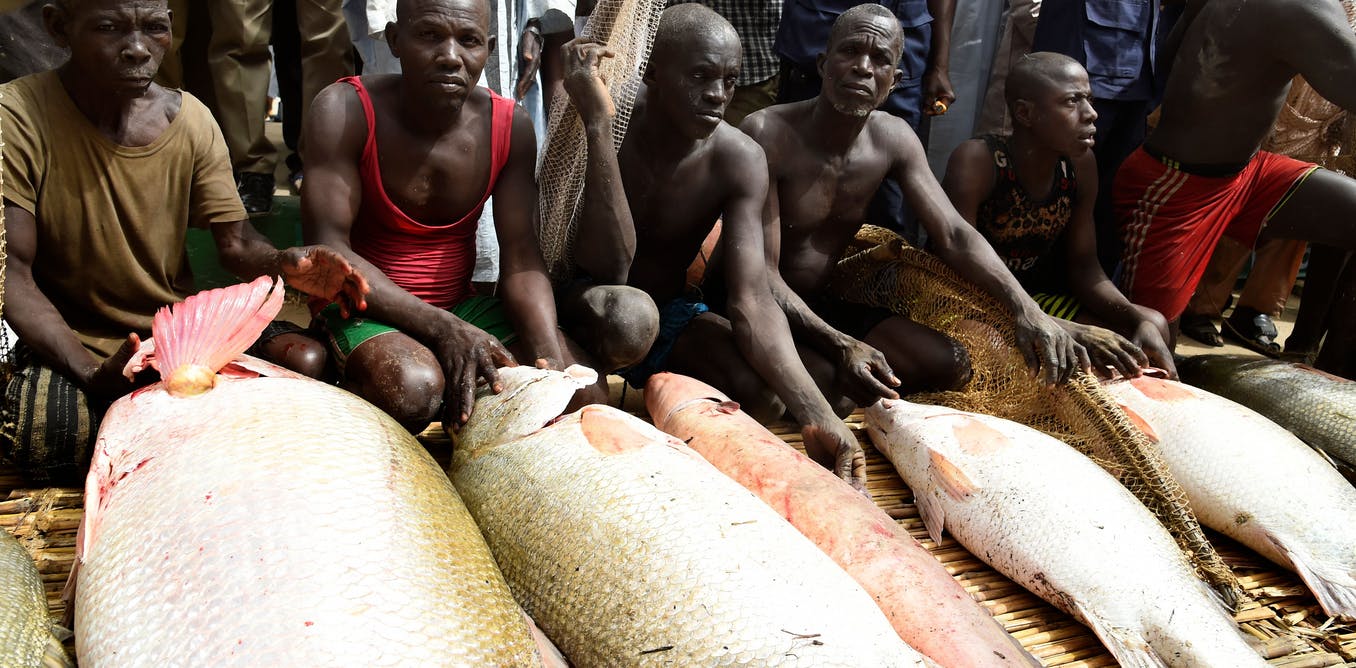
Like most countries in West Africa, Nigeria’s coastal waters contain diverse species of fish, which contribute to the food and economic security of its people.

Small-scale fishing operations contribute 80% of locally produced fish and support the livelihoods of 24 million Nigerians. Seventy three percent of those involved in fisheries in Nigeria are women.
The overall GDP contribution from fishing – small scale and industrial – was 0.84% in 2019 and 1.09% in 2020.
The fisheries sector is therefore a route to socioeconomic development in Nigeria. But it also faces threats.
One of these is environmental pollution, primarily from the oil industry. Pollution degrades the maritime environment, destroys fish stocks and reduces the catch.
Another threat is illegal fishing, as our previous research has found. Our current research continues to explore how women, in particular, are affected by and responding to these threats.
The first step is to understand the scale and complexity of illegal fishing and associated crime, and why it is happening.
Scale and costs
Recently, the Nigerian House of Representatives noted that the country loses $70 million each year to illegal fishing. This includes loss of licence fees, revenue from taxation and the value that could have been accrued from legitimate fishing by local vessels.
Other sources estimate the cost of illegal fishing in Nigeria as much higher, citing anywhere between $600 million and $800 million each year.
The variation in these figures reveals the difficulties in calculating the costs of clandestine activity. It’s also a result of budgetary neglect of the Nigerian Federal Fisheries Department. The department lacks the capacity to monitor, survey and control vessels operating in Nigeria.
Vessels from China, the European Union, and Belize are notable for illegally exploiting Nigerian waters.
Despite varying estimates, all sources agree that the economic losses caused by illegal fishing in Nigeria are high. But the figures alone paint a superficial picture of the true costs of illegal fishing. Illegal fishing does not occur in isolation.
Fisheries crime
Fisheries crime denotes a vast and diverse category of illegality and criminality that aids or accompanies illegal fishing. Such crimes can include corruption, customs fraud, human and drugs trafficking and piracy. Illegal fishing and fisheries crime also threaten human rights.
Our previous research found that illegal fishing was undermining people’s livelihoods. The lack of government support to address illegal fishing and protect livelihoods within fishing communities further pushes people into poverty. This makes them vulnerable to criminal networks.
Fisherfolks may end up participating in, and being victimised by, fisheries crime as a result. This is evidenced in increasing criminality through rising incidents of piracy and armed robbery at sea throughout Nigeria’s coastal communities.
Maritime insecurity also has a gender dimension. Women in West African fisheries face unique challenges and risks such as poor access to capital, growing competition for access to depleting fish stocks, and policy exclusion.
Neglect and poor regulations
Despite the important contribution that fishing makes to the livelihoods of Nigerians, government neglects this sector. This is evident in the marginal budgetary allocation the sector receives yearly.
The Monitoring, Control and Surveillance Department of Nigeria’s Federal Fisheries Department is critical to managing Nigeria’s fisheries. Yet no budgetary allocation has been made to it in the last 15 years.
The Monitoring, Control and Surveillance Department lacks patrol vessels, and is therefore unable to monitor the activities of vessels operating in Nigeria. In 2017, the government announced plans to purchase patrol vessels, but it hasn’t done so yet.
The sector doesn’t receive enough funding to function effectively. Nigeria’s Fisheries Department operates within the country’s Federal Ministry of Agriculture and Rural Development, which was allocated less than 2% of the national budget in 2019.
Existing fisheries regulation is also inadequate. Nigeria’s fisheries are governed by the Sea Fisheries Act of 1992. These regulations are outdated and ill-equipped to address the current scale and severity of growing fisheries crime.
For example, in June 2020, a vessel, Hai Lu Feng 11, was fined ₦3 million (under $7,300) for switching off its Vessel Monitoring System while in Nigeria’s Exclusive Economic Zone.
The Vessel Monitoring System is designed to provide estimates of fishing activity in near real time. Switching the system off suggests an intent to evade detection by the authorities. But this fine is tiny when considering the millions of dollars that illegal fishing costs the Nigerian economy each year.
Solutions to illegal fishing
Solving the problem of illegal fishing in Nigeria requires that the Federal Department of Fisheries is supported to operate effectively. As the agency charged to ensure the sustainable exploitation of Nigeria’s fisheries, it must be adequately funded.
Current fisheries regulations must also be updated to reflect the current realities and impacts of fisheries crime.
A holistic and collaborative approach is critical to addressing fisheries crime. A national maritime security strategy is needed to guide and facilitate inter-agency and regional cooperation. The strategy should include the establishment of an information-sharing platform.
The capture of the pirates that targeted Hai Lu Feng 11 vessel by the Nigeria navy was supported by the Fisheries Committee for the West Central Gulf of Guinea. This was through the regional online communications platform established under the West Africa Task Force.
This shows that cooperation between fisheries agencies and other maritime enforcement agencies is critical to stemming the tide of illegal fishing – and other crime at sea.