
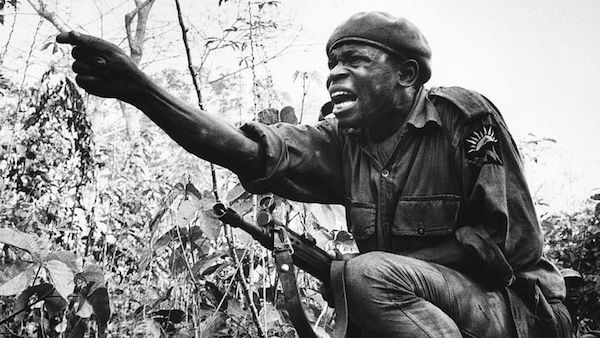
This year marks the 50th anniversary of the end of the Biafran conflict in 1970.

The trigger for the conflict was the proclamation by Colonel Odumegwu Ojukwu on 30 May 1967 that Biafra had become a republic. After 30 months of war, Biafra surrendered and was once again incorporated into Nigeria.
According to the author John de St Jorre, between half a million and a million Nigerians died, mainly from starvation, during the war.
Through the efforts of their roving diplomats during the war, Biafra achieved recognition from the states of Tanzania, Gabon, Haiti, Ivory Coast, and Zambia. But the fledgling state struggled to secure wider diplomatic support. It also found it difficult to purchase weapons and smuggle them into its controlled territory via airlift.
The efforts of these diplomats have recently come to light through the decryption of telexes sent from Portugal to Biafra during the war. Telex, short for teleprinter exchange, was a method for transmitting messages electronically over land lines or radio. Lisbon, the capital of Portugal, had become the centre for Biafran diplomacy in Europe because the government of Portugal under António de Oliveira Salazar supported Biafra with air landing and communication privileges. Paris and London were also key centres for Biafran diplomats.
In our paper we set out what was in the encrypted messages, and how we solved them. Three of us worked on the project, each with different disciplines – a mathematician, a computer scientist and a radio technologist. We used manual and computerised cryptanalysis methods to decipher a series of transposition ciphers sent by Biafran officials in 1968 and 1969.
It took us three months to figure out how the encryption worked and what keys were used. We also needed to read about the context of the war to understand and interpret the messages. The historical figures were unfamiliar to us and many codewords were used for people, countries and objects.
In the end, the decrypted messages provided a treasure trove of information about how men and women working for the breakaway state in Europe tried to garner support for Biafra from afar during the war.
Decades long decryption project
At the time, the Biafrans sent some of their messages in plain English text and made some extra effort to encrypt some in order to ensure that at least casual eavesdroppers couldn’t read the encrypted ones. However, they made mistakes which meant that professional as well as amateur eavesdroppers could have read them.
We know of at least two professional organisations that did intercept them: the Swedish signals intelligence agency, the FRA, and the US Central Intelligence Agency (CIA).
Some were also intercepted by at least one amateur radio operator, Frode Weierud, in Oslo, a co-author of our academic paper.
At the end of July 1969 Weierud discovered a signal in the shortwave band transmitting a regular message in radioteletype: “This is Biscaia testing to LDA/3”.
Using teleprinter devices, he was able to intercept a series of messages from the station “Biscaia”. The messages were initially in understandable English, but soon they started arriving in ciphertext, in both five-letter and five-figure groups.