
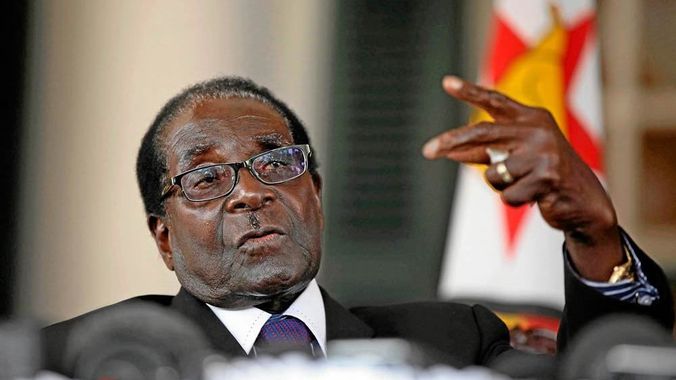
Zimbabwe has known only one leader since independence. First as prime minister, then president, there has only been Robert Mugabe at the top for the last 36 years. There have been challenges, opposition and violence, but the 92-year-old leader has always known how to deal with dissent and stay in power, frequently using brutal tactics. But now there are protesters, young and leaderless, united by social media. Erstwhile confidants of Mugabe, themselves liberation war heroes, are emerging to challenge him for political leadership. And members of the security forces, so key to maintaining order, are no longer unquestioningly loyal. Are all of the ingredients finally in place for a change in Zimbabwe.

“OUR FUTURE IS BEING DESTROYED”
That’s what the activists would have you believe. They are a new breed for Zimbabwe, growing up under Mugabe, and they seem fearless and ready to be counted. “Let them see us,” says Hard life Mzingu of the Tajamuka campaign. Translated, the movement’s name means ‘we are fed up’. Unlike previous opposition movements, they don’t have a single leader to depend on, who could disappear or be discredited; instead they have social media to reach and unite thousands. ”We have a future that is being destroyed in this country. And it is our role in this country to rebuild that future,” says Mzingu. “These are young people, across the political divide, across creeds, across social divisions in the country, who have met and resolved they have to fulfill our generational mandate. “ That mandate, he says, is to push Mugabe out.
For weeks now they’ve stood up to Mugabe’s security forces on the streets of the capital Harare in what are quickly becoming weekly protests. Armed with smart phones, they capture the confrontations. There’s the video of the protester dressed in bright red on the steps of the court house, turning briefly to face the five riot police that surround him. He raises his arms and they raise their batons, beating him from all sides.
“MUGABE MUST GO”
It’s videos like that, and the countless still images of abuse shared on Whatsapp, that are driving these activists. But they know, for the movement to work, it needs to take hold outside of the capital city and in the rural strong holds of Mugabe’s ZANU-PF party.
As dusk approaches, we follow them away from our meeting spot at an upscale shopping center and down one of the roads leading outside of Harare. “Wait here,” says one of the activists as they slip through the gate of a non descript cement house. A few moments later they return and invite us in. A crowd of about 30 sits in the backyard as chickens scuttle around. All of them are wearing white “Mugabe must go” t-shirts. They say the t-shirt alone could get them beaten or arrested. ”How many people from your area can we count on tomorrow?” one of the leaders asks those gathered. “One hundred? Can we count on that? If you bring 100 people, we’ll make sure to provide you with transportation.” ”Tomorrow” is another protest planned over social media. The courts have just overturned a government order banning demonstrations for two weeks and the activists don’t want to waste any time getting back on the streets, where they expect to face tear gas and worse. ”We are not afraid of what will come,” says Mzingu.
POLICE LOYALTY WAVERS
The same court ruling has put Mugabe’s security forces on edge. For days we’ve been trying to set up a meeting with a veteran Harare police officer and now that face-to-face is in jeopardy. He’s been called in to another emergency meeting on how to deal with the expected fresh round of protests; he’s not sure if he can make it. For more than three decades, Mugabe has used state security to brutally crush dissent.
The response from police has always been an unquestioning, unwavering loyalty to him and obedience. But that too is changing and so are our plans. The police officer texts to say he’s on his way. He could lose his job or worse, get arrested for what he’s about to tell us. But he’s determined to talk. We are hiding his identity for his protection. What he says smashes the veneer of unity in Zimbabwe’s state security apparatus. “I think people don’t know what is actually happening in Zimbabwe, particularly within government institutions like the police, the army,” he says. “They see us on the streets beating up people, they think it is from our own liking, but that is not the case.” He says following orders is becoming harder and harder for his fellow officers and that they are being used as political pawns.
Demands from Mugabe’s ruling ZANU-PF party trump their training, their orders. ”We are briefed by our superiors, we are briefed not to beat up people, but when we are on the ground, the instructions changed,” he says. Those new instructions, he says, outline a very clear order of escalation. “Eventually we are going to use live ammunition. They talk of the use of tear smoke, they talk of the use of animals, of dogs and horses and the like, and the last one is the use of firearms. In that order.” A presidential spokesman denied allegations that Mugabe’s party is ordering the police to attack protesters. ”It’s not the case,” said George Charamba simply.
“LIVE AMMUNITION IS NEXT”
But the revelations shed a new light on the repeated allegations of abuse by state security in Zimbabwe. Prominent human rights lawyer Harrison Nkomo says that Mugabe is running rough shod over the Zimbabwean constitution, which guarantees the right to protest. ”One would want the government to hear those voices and implement on their concerns,” Nkomo says in his office, around the corner from where some of the biggest demonstrations have occurred. “But instead we are getting the opposite. We don’t want you to say out your views. And how do we make sure you are not heard? We crush you before you express yourself. “ When asked if he’s afraid someone is going to be killed, the police officer answers without hesitation. ”If the momentum of these demonstration continues, I think eventually they are going to use live ammunition. That is my worry.”
REVOLUTIONARY ONCE MORE
The government appears to be settling in for a battle with street protests, but some say the real danger for Mugabe comes from within. We drive out into Mashona land, about 90 minutes from the capital, past giant commercial farms growing wheat and citrus. Many of them were taken from white farmers and foreign corporations and handed to Mugabe loyalists under the government’s “land reform” program after independence from white rule. One such farm is now owned by Agrippa Mutambara. We arrive as he is giving farm hands orders, gray suit pants hitched over his blue shirt with suspenders.
During the bloody liberation struggle of the 1960s and 1970s, Mutambara called himself “Dragon” and he was a key field commander. After independence he took diplomatic posts in the critical ally nations of Cuba, Russia and Mozambique. Now, he has turned his back on Mugabe, saying he is tired of the way the ruling party used fear and intimidation as its main tools. “We attained independence, yes. We were able to exorcise the colonial demon. In its place we also created another demon.
Until there is a change in the way that government is run in Zimbabwe, the revolution must continue,” he says. It was that outspoken criticism, he says, that caused about 50 Mugabe loyalists to pile out of trucks and cars to try to invade his farm recently. ”They said ‘you are a traitor,’ then some of them started scaling the fence. At that time I took my pistol and cocked it. When I did that, they all went down.” Mutambara is part of a growing number of senior politicians and war veterans who are joining Joice Mujuru’s Zimbabwe People First Party. Mujuru, a former Vice President, was turfed out of ZANU-PF in 2014. Now, she hopes to exploit the divisions in the ruling party and the discontent in the country, in the belief that can lead to triumph in the 2018 scheduled elections.
A PERFECT STORM
Right now, Zimbabweans have a lot to be protesting about. Put simply, the country is running out of cash. Since the hyperinflation of 2009, Zimbabwe depends largely on the US dollar. And the cash liquidity crunch is extreme. Each day, long lines form at banks in the capital, as citizens try to pull out their money. Banks place a cap on withdrawals to avoid a bank run.
Former teacher Kudzai Gonorenda, waiting in line outside a bank in Harare, says that makes everyday life almost unbearable. ”If you have money in the bank, but you can’t access that money, because of the cash crisis, then it is difficult,” he said. The government has been struggling to pay its civil servants – a large chunk of the national budget — and has paid late or less than usual when it can.
Proposals to print a so-called bond note pegged to the dollar have been met with protests and suspicion by the general public. Though the International Monetary Fund does commend the government for making some tough reforms, it says that no more loans will be forthcoming until it clears the $1.8 billion in debt that it holds with multilateral lenders. A deal to get emergency funding, though, is not off the table yet.
A NEW ALLIANCE
The macro-economic crunch is made worse by a crippling drought that will leave more than four million people in need of help, according to the United Nations. Exacerbated by a punishing El Niño cycle, farmers in large parts of the country have been unable to grow their crops.
And the cash-strapped government doesn’t have the funding to provide substantial help. One long-time Zimbabwe watcher calls it a “perfect storm.” Among the civil servants who are paid months late, if at all, is the police officer who spoke to us. ”Our bosses, they have got allowances that they can actually use to sustain themselves. But for the lower ranks, as in my case, you can’t source money from anywhere,” he says.
It’s a thread of anger that we hear time and again in Harare. An anger between the politically powerful haves and the have-nots. And it’s creating what could be a new kinship, a new alliance. ”The very same people we are beating, some of them are my school mates,” says the police officer. “Some of them are my friends, or people we live with in the community.”
CNN