
The naira suffered its weakest performance in recent weeks at the beginning of the new week after Nigeria’s foreign exchange (forex) reserves recorded its first depletion in six weeks.

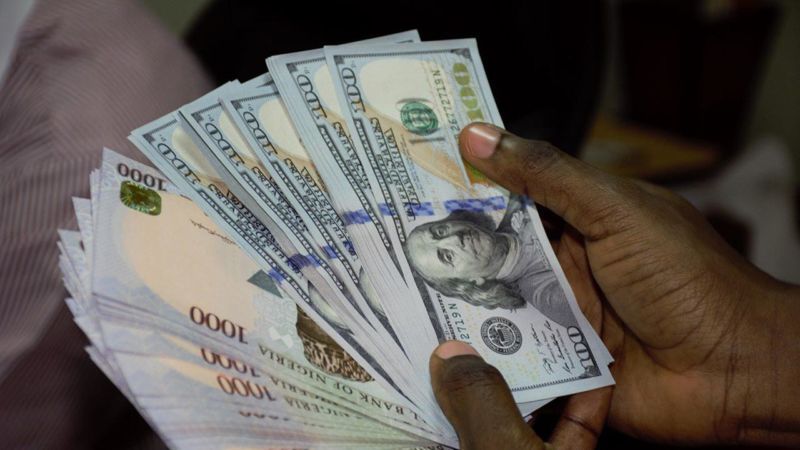
The naira closed weaker at the official and parallel markets, the first all-round negative performance in recent weeks, exchanging for N520 to a Dollar.
The British Pound Sterling opening rate was N708/£1 while the Euro stands at N606/€1.
However, at the official market, the Investors and Exchange (I&E) window, the Naira began trading at the same rate from last week.
According to FMDQ Securities Exchange data, this week’s starting rate was N411.67per $1, the same rate it opened last week.
Meanwhile, the expected foreign currency inflows from Eurobond issuance of $6.2 billion and the $3.4 billion SDRs (Special Drawing Rights) from the International Monetary Fund (IMF) will have a significant boost on Nigeria’s external reserves.
However, data from the Central Bank of Nigeria revealed that Nigeria’s external reserves have dropped by 0.21 percent in one week.
Tracking data sourced from the CBN’s website showed that Nigeria’s forex reserves declined by $63.1 million to $33.52 million, halting a five-week consecutive increase in national gross forex reserves.
The naira followed the decline, depreciating by 0.1 per cent to N411.67 per dollar at the official Investors and Exporters (I & E) Window and by one per cent to N520 per dollar at the parallel market.
According to financial experts, the speculative activities at the parallel market will keep the exchange rate volatile in the next few weeks.
“However, upon receipt of the IMF’s SDR credit of $3.35 billion expected on August 23, we expect gross external reserves to increase to about $34 billion. This will provide more support for the CBN to support the currency and lead to a further convergence of the exchange rate around the I & E window,” expert from Financial Derivatives stated.