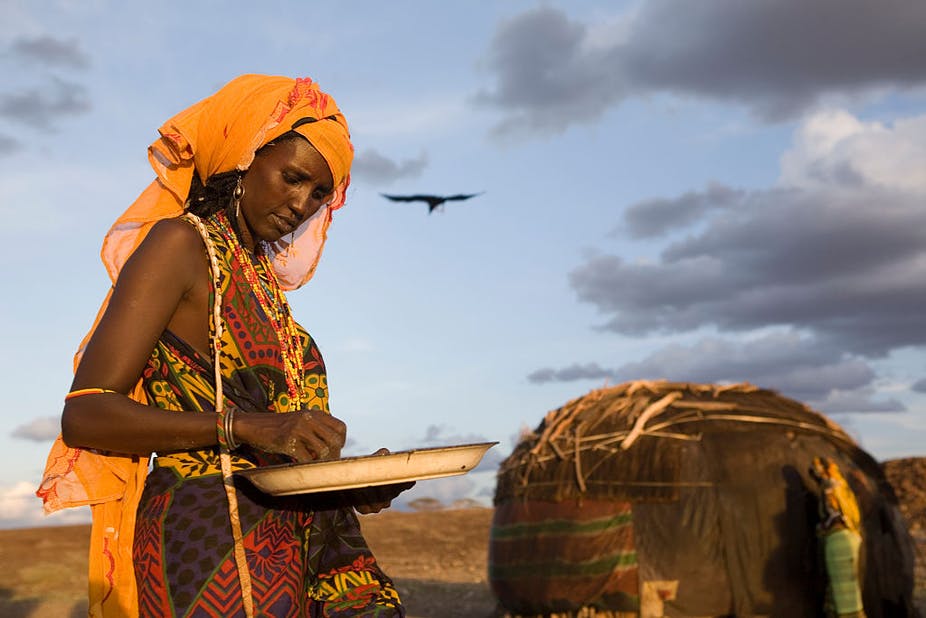
Traditionally, there is no word for business among the pastoralist communities of the arid Marsabit County, in northern Kenya. Nor do they have words for any of its most common terms, such as profit. Instead, they have a lexicon associated with a different set of principles: mutual aid, generosity, sharing.

These deeply rooted values have shaped their sense of self and community for generations, determining both individual and collective behaviour.
But this is changing. In recent years, the people in this region, which borders Ethiopia, have started to grapple with a new reality –- that of becoming business people. Aid agencies have started to work with them and help them build more sustainable livelihoods through business. Pastoralists are now increasingly engaging in businesses such as livestock trade and retail trade of small items such as sugar, tea leaves, and washing powder.
Building business skills to improve livelihoods is increasingly being recognised and promoted as a mechanism to lift communities out of extreme poverty. The logic goes that if you give people the tools they need to understand the basics of business, they can become more self-confident, autonomous, resilient, and skilled at turning a profit. In short, to move from survival to success.
So far so good. But the difficulty is that in many survivalist communities the principles of business can clash with the existing values of the community, as I found in my recently published research. My study followed 51 participants of a livelihood improvement programme in Marsabit County from May 2016 to February 2019.
For people with a strong collectivist identity founded on generosity and caring, the idea of selling goods for profit or of saving money for oneself for instance can be hard to implement. The friction between these two identities can generate both individual frustration and conflict in the community as people struggle to simultaneously fulfil the demands associated with both identities.
For many, becoming a business person is more than a personal journey towards prosperity. It is a complex process of individual and social identity change. And while this has immense potential to help lift people out of extreme poverty, such a transition has inherent difficulties.
There’s greater potential to make it work if prevailing identities are honoured and care is taken to ensure that the entire community is respectfully included.
Helping people forge new identities
Building business skills to improve livelihoods is increasingly recognised as bringing value to the fight against poverty. But it can also set up identity conflict and community-level tension, unless care is taken to address prevailing ways of being and behaving.
Fortunately, identity is not a unitary construct, nor is it static. Part of identity formation is dealing with conflicting ideas and the continued integration of new roles. What’s more, this process is critical. My research has shown that the way people respond to this identity conflict will shape what type of business person they become – and, by extension, what kind of community they co-construct.
Typically, when the collectivist identity collides with the business people identity, participants choose one of three scenarios.
Those for whom helping neighbours in need is most important prioritise collectivist identity demands and become a collectivist business person. They are more likely, for example, to provide handouts of business goods.
Those for whom the collectivist identity is less important could go to the other end of the spectrum and become an individualist business person. They may refuse to help others through their business or offer help with strict terms and conditions.
Or they could become more of a hybrid kind of business person who tries to find ways to meet both sets of identity demands. They could, for example, give some handouts of business items on one hand, but charge interest on goods on credit to increase profit on the other.
Understanding this dynamic is essential for helping participants progress without severing connection to their core values or alienating fellow community members. A greater appreciation of existing identities and the identity conflict that arises with the introduction of new ideas will equip aid agencies to help people and communities transition more smoothly.
Four ingredients of success
To ensure greater success in such initiatives, development practitioners need to focus on four elements, which emerged from my research. First, it is important to incorporate the notion of identity into the programme model. Whether intentionally or not, practitioners are helping participants construct new identities through training, mentorship, examples of success, and even through the questions they ask.
Therefore, it is important to think about the types of identities they are helping participants construct (such as the business person identity) or reconstruct (such as the prevailing community member identity).
Second, take time to understand what identities potential participants already have before you start. And how these may shape behaviour on an individual and collective level. What does it mean to be a member of the community, woman or man, mother or father, in that context? What are the important religious or other related beliefs? Is there a strong collectivist or individualist culture at play?
In addition, think about what tensions may arise with the introduction or reinforcement of certain identities.
Third, tailor programmes to address existing identities and potential identity dynamics. This can include building on existing identities. Or it could help participants navigate identity tensions and community resistance to new behaviours and expectations.
Finally, think about how to bring communities up together. Resistance to new behaviours and expectations can be exacerbated when some members of a community receive training and others do not. Community-level learning and enterprises will limit the likelihood of collective resistance to new behaviours and expectations. It also discourages in-group and out-group formation, and community stratification.